Junk removal
Concrete, Dirt & Heavy Material Removal
Heavy material is the junk that does not look like much until you try to move it. A small pile of broken patio will fill a wheelbarrow forty times and still be there. Junk Rhinos handles concrete removal and dirt removal for homeowners and small contractors: broken slabs, pavers, brick, block, stone, soil, gravel and tile, loaded by hand and hauled away in the right number of loads.
Heavy jobs are priced a little differently from a couch or a garage cleanout, because weight fills a truck long before volume does. This page explains how that works, what we take, and what you need to sort out before the crew arrives, so the price you hear on-site makes sense.
- Insured, uniformed crews
- Free on-site estimate
- No deposit, no hidden fees
- Same or next-day in most areas
- We donate & recycle first
Published prices
What concrete removal costs
Heavy loads use the same truck tiers as every other job, with weight counted in: from $290 for tile and mortar from a room or two, and from $590 for a broken-up 10x10 slab. Concrete, dirt, brick and tile are priced by weight as well as volume, so the firm, all-in price is confirmed free on-site.
- Single item~1/16 truckfrom $199
- 1/8 truck~half a pickup bedfrom $199
- 1/4 truck1 pickup bedfrom $290Typical for this job
- 1/2 truck~2 pickup bedsfrom $450Typical for this job
- 3/4 truck~3 pickup bedsfrom $590Typical for this job
- Full truck~18 cu ydfrom $729Typical for this job
Examples
- Tile and mortar debris from one or two rooms1/4 truck, from $290
- Broken concrete from a small patio or walkway (a quarter to half truck)1/4 truck, from $290
- Pavers from a 100-150 sq ft patio, or brick and block from a garden wall about 20 feet long1/2 truck, from $450
- A 10x10 slab about 4 inches thick, broken up3/4 truck, from $590
- Several cubic yards of dirt (can need two loads)3/4 truck, from $590
Ballpark prices from our published rates. The crew confirms your firm, all-in price free on-site before any work starts. No deposit. Pay online when you book, or after the job.
Why heavy material is its own kind of job
Most junk is light and bulky. A truck full of furniture is limited by space. Concrete, dirt, brick and stone are the opposite: a cubic yard of solid concrete weighs roughly two tons, and soil is not far behind. A truck full of concrete is not a full truckload by volume, because the truck reaches its safe weight limit when the bed is only partly full. Load it to the top and you have an overweight truck, not a bargain. It is also why, if a concrete removal quote sounds too good, it is worth asking how many loads it includes: overloaded trucks and surprise second trips are how heavy jobs go wrong.
Disposal is different too. Facilities that take concrete and dirt usually charge by weight, not by volume, and some separate clean material from mixed loads. Add the labor of carrying heavy pieces across a yard one at a time, and you get the reason heavy material has its own pricing.
What our concrete and dirt removal includes
Estimate on-site
The crew looks at what you have, how much of it there is, and how far it has to be carried, then confirms a firm price that already accounts for weight.
Breaking down
Already broken concrete is loaded as-is. Crews also break up small intact slabs such as a patio, walkway or shed pad; mention one when you book so the right tools come along.
Loading by hand
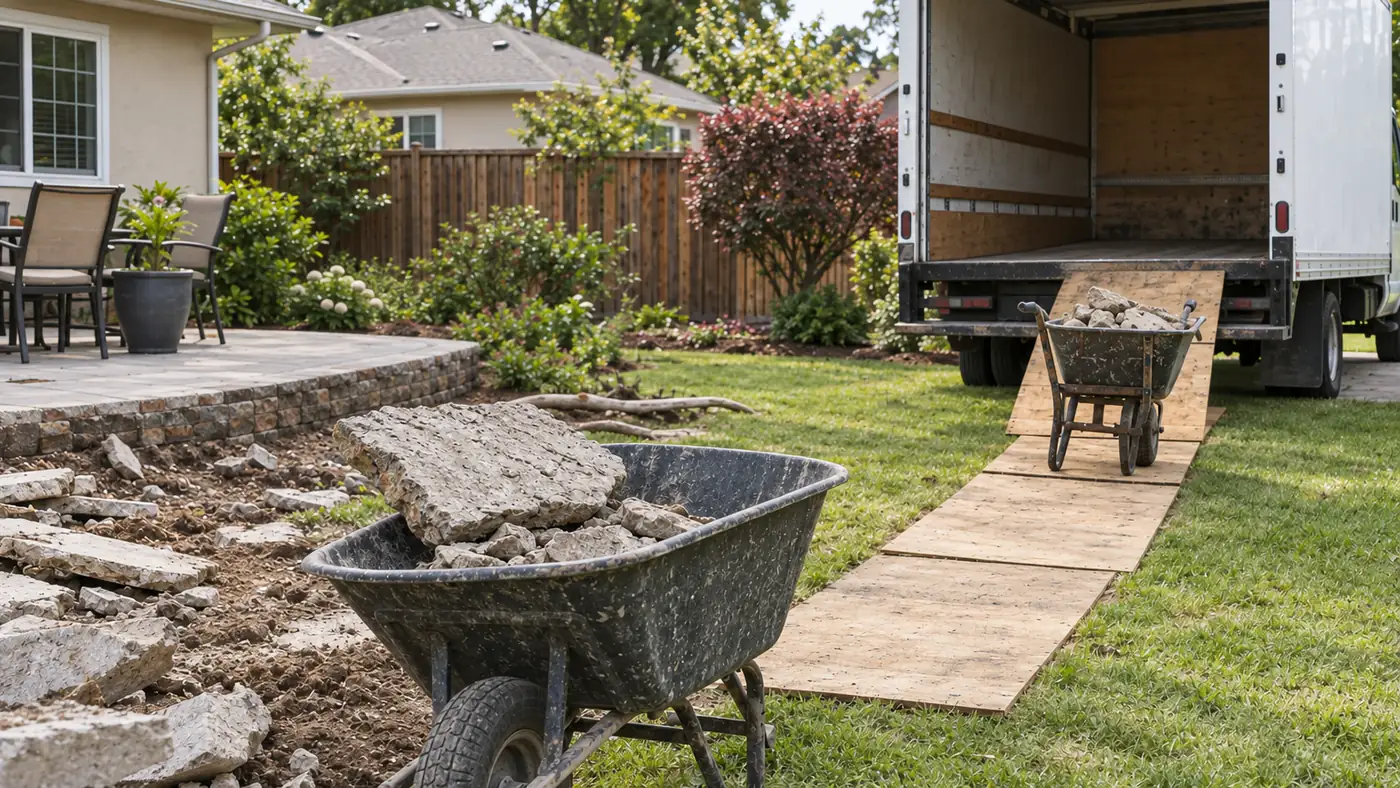
Pieces are carried or wheelbarrowed to the truck, with boards down over lawns and walkways where needed.
Hauling in the right number of loads
Heavy jobs are loaded to the truck's weight limit, not its height, so larger jobs may take more than one trip.
Sweep and rake
Paved areas are swept and soil areas raked clear of chips and fragments.
Heavy material jobs we handle
These are the calls that make up most of our heavy-material work, and the details that change each one.
Broken concrete from a patio or walkway
The most common version: someone, maybe you, broke up an old patio or walkway and now there is a pile of jagged slabs by the fence. We load it and haul it. Concrete with wire mesh or rebar is still removable; mention it so the crew plans for it.
Intact slabs and shed pads
A slab that has not been broken yet is a different job. Breaking concrete takes a jackhammer or a saw, and our crews handle small slabs, such as a 10x10 patio or the pad left after a shed removal. Driveways, thick foundations and heavily reinforced slabs usually need a concrete contractor with heavy equipment. We will tell you which side of that line your slab falls on.
Pavers, brick, block and stone
Pavers from a patio redo, bricks from a garden wall, cinder block from an old retaining wall, flagstone and landscape rock. Clean, stacked material loads faster than a mortar-crusted pile, but both go. Good-condition pavers and bricks are sometimes worth offering locally before we haul them.
Dirt removal and soil piles
Leftover soil from a garden bed, a pool base, a trenching project or a landscaper's job. Dirt removal is heavy work and wet soil is heavier still. Clean dirt with nothing mixed in is the easiest to place; dirt mixed with roots, rocks, concrete chunks or trash is mixed fill and costs more to dispose of.
Gravel and decorative rock
Pea gravel from an old play area, river rock from a dry bed, crushed stone from a path. If it is still spread out, it needs to be raked up and shoveled, which takes more time than loading a pile.
Tile and mortar debris
Tile from a bathroom or kitchen tear-out is heavy in the same way concrete is. We haul the debris once it is up. If you need the tile removed from the floor first, see our carpet and flooring removal page.
Mixed heavy loads from a landscaping project
A backyard redo often produces a bit of everything: an old border wall, some broken patio, a heap of soil and a dead shrub or two. All of it can go on the same job, and branches and brush are covered on our yard debris page.
Straight talk
Before we arrive
Call 811 before anyone digs
811 is the national call-before-you-dig number, and most states require a locate request before excavation. If your job involves digging, even a shallow trench or pulling out a buried footing, request a locate a few days ahead so buried gas, power and water lines are marked. That applies whoever is holding the shovel.
Break up what you can, or tell us it is intact
If the concrete is still a slab, say so when you book. It changes the crew, the tools and the price, and for a driveway or a thick foundation it changes whether we are the right call.
Keep heavy material separate
Clean concrete, clean dirt and clean brick each have better disposal options than one big mixed pile. If you are still working, keep them in separate heaps. It can lower the price.
Clear a path
Heavy material moves by wheelbarrow, so a clear, firm route from the pile to the driveway makes everything faster. Let us know about steps, slopes and soft lawns.
What we take and what we do not
- Broken concrete, with or without wire mesh or rebar
- Small slabs, patios, walkways and shed pads, broken up on-site
- Pavers, brick, cinder block and concrete block
- Flagstone, landscape rock and stone
- Clean dirt, topsoil and mixed fill
- Gravel, pea gravel and crushed stone
- Tile, mortar and grout debris
We do not take soil contaminated with oil, fuel or chemicals, or asbestos-containing materials, including some old tile, mastic and cement board. Paints, solvents, sealers and other hazardous materials are excluded too; your household hazardous waste program is the right home for those.
What does concrete removal cost?
Concrete removal cost depends on weight more than size. We start from the same truck tiers as every other job, then adjust for weight, since a load of concrete reaches the truck's limit long before it reaches the top of the bed. Density, moisture, how much rebar is in it and how far it has to be carried all move the number, and the crew confirms a firm, all-in price on-site, free, before anything is lifted.
For a sense of scale, once weight is counted: tile and mortar debris from one or two rooms usually lands around a quarter of the truck, and a pile of broken concrete from a small patio or walkway a quarter to half. Pavers from a 100-150 sq ft patio, or brick and block from a garden wall about 20 feet long, typically come to about half. A 10x10 slab about 4 inches thick, broken up, or several cubic yards of dirt usually counts as three-quarters of the truck or more, and dirt can need two loads. You can see how the truck tiers work on our pricing page.
- Priced by the truck space your load fills, adjusted for weight
- Firm, all-in price confirmed free on-site
- No deposit, and nothing owed until it is done
- Labor, hauling and disposal fees all included
How weight changes the price: a worked example
Take a 10x10 patio slab about 4 inches thick. That is about 33 cubic feet of concrete, roughly 1.2 cubic yards, and at roughly two tons per cubic yard of solid concrete it weighs close to two and a half tons.
By volume, the broken pieces would fill only a corner of a truck that holds about 18 cubic yards. By weight, it is a much bigger job: the truck reaches its safe weight limit long before the bed is full, disposal is usually charged by weight, and every piece is carried out by hand. That is why a broken-up 10x10 slab counts as three-quarters of the truck or more, from $590, even though it takes up a fraction of the bed.
The crew works the weight into the firm, all-in price at the free on-site estimate, and the price confirmed on-site is the price you pay.
How long does it take?
A pile of broken concrete or a few rooms of tile usually takes a couple of hours. A garden wall or a few yards of dirt can take half a day. Breaking up an intact slab adds time, and jobs that need more than one load take longer again. The crew gives you a realistic timeline at the estimate.
What happens to the materials
Concrete is one of the most recyclable things we haul. In most areas it goes to facilities that crush it into aggregate for road base, fill and new concrete. Clean brick and block often follow the same route. Clean dirt can go to fill sites or reuse, while mixed fill goes to disposal. Pavers and bricks in good shape are worth reusing, and tile and mortar debris goes to the appropriate disposal facility.
Frequently asked questions
How much does concrete removal cost?
It depends on how much there is, how heavy it is and how far it has to be carried. A small pile of broken concrete takes a modest share of the truck once weight is counted, while a broken-up slab can take most of a truck or more. The firm, all-in price is confirmed free on-site before any loading.
Why does concrete cost more to haul than other junk?
Weight. A truck reaches its weight limit with concrete long before it is full, and disposal is charged by weight. The price reflects both.
Do you break up concrete slabs?
Yes, for small slabs such as patios, walkways and shed pads. Driveways and thick or heavily reinforced slabs usually need a concrete contractor.
Can you take concrete with rebar in it?
Usually, yes. Mention it when you book so the crew plans for it.
Do you offer dirt removal?
Yes. We load and haul piles of soil, topsoil and fill. Clean dirt costs less to dispose of than dirt mixed with debris.
Do you dig out dirt, or just haul it?
Most dirt removal jobs are piles that are already dug. If digging is involved, ask when you book, and call 811 before anyone digs.
Can I find concrete removal near me this week?
Local crews cover most areas, often with same-day or next-day slots. Heavy jobs sometimes need more planning, so book with a rough quantity and a photo.
Do you take bricks, pavers and cinder blocks?
Yes. Good-condition pavers and bricks may be worth offering locally first, but we take them either way.
Can you remove the slab left after my shed comes down?
Yes. It can be done on the same visit as the shed removal if it is booked together.
Do you take old tile?
Yes, once it is up. Some older tile and adhesive can contain asbestos. If you suspect it, have it tested before removal.
Do you take gravel and landscape rock?
Yes. Raked-up or piled gravel and rock are priced like other heavy material.
Do I need to call 811 before a footing or post comes out?
Yes. Breaking out a footing, pulling a post set in concrete or lifting anything that sits below grade is digging, and the 811 before-you-dig service says every digging project, regardless of depth, needs a request a few business days ahead. The request is free, and utilities mark their buried lines with paint or flags so nobody hits them.
How long you wait depends on your state, as 811's homeowner steps explain, so confirm that every utility has responded before work starts. The federal Pipeline and Hazardous Materials Safety Administration warns that skipping the request can leave you liable for damage costs and repairs, plus potential penalties. On our deck removal and fence removal jobs, posts are cut at grade unless pulling the footings is agreed at the estimate and priced by weight.
Sources we checked
Rules and fees on this page come from these official sources. Local rules can differ, so check with your city or county too.
How to Choose a Junk Removal Company (10 Questions to Ask)
The questions to ask before you book, including whether heavy-item add-ons can appear after loading.
What Happens to Junk After Removal? Inside Our Donate-First Process
How a load is sorted before it leaves your property, and what goes to recycling versus disposal.
Ready when you are
Get the broken patio, the brick pile or the dirt mound out of your yard for good. Call (877) 283-1595 or request a free estimate online, and you will know the number of loads and the firm price before a single slab is lifted.