Specialty removal
Deck Removal & Demolition
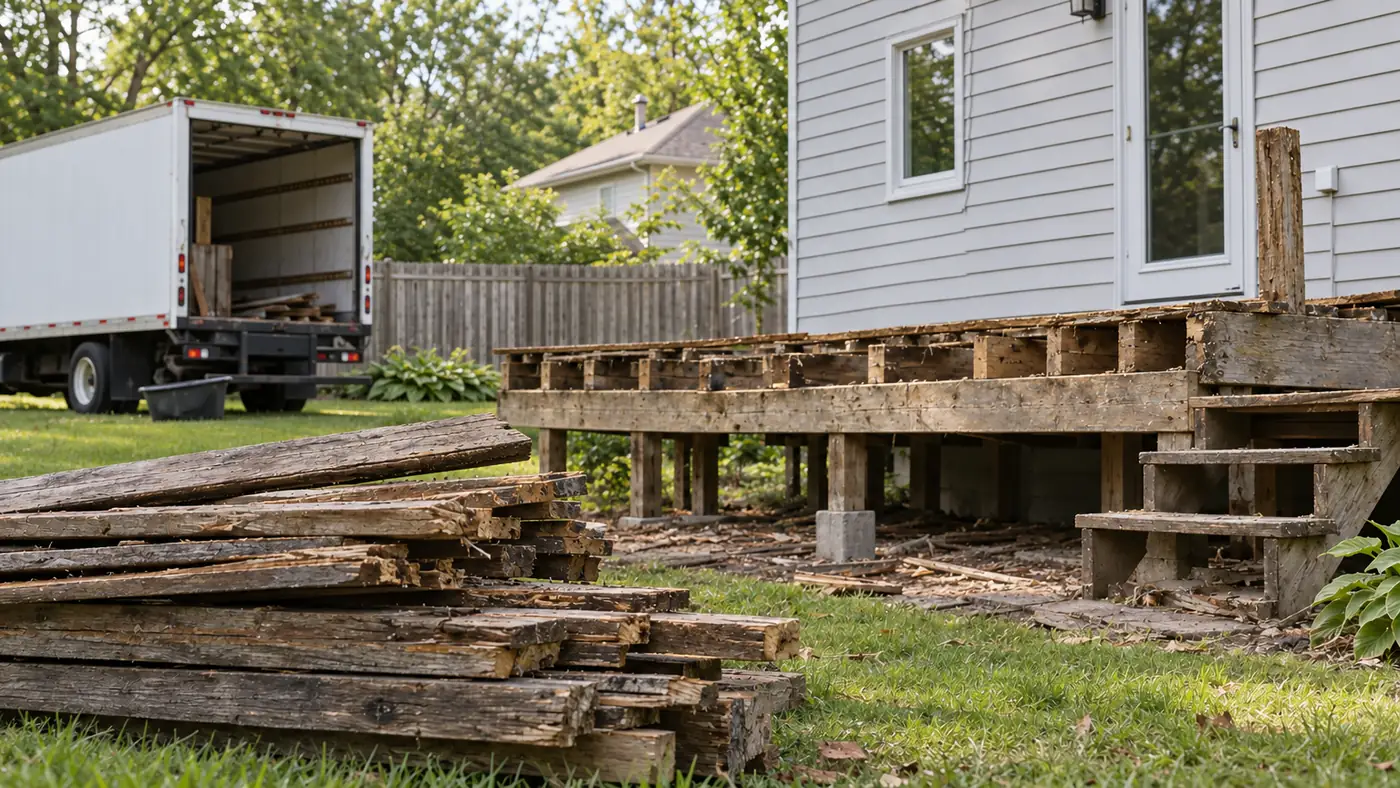
Decks fail slowly and then all at once. First a board goes soft, then the railing starts to wobble, and one day somebody steps on the stairs and the stairs have opinions. Junk Rhinos handles deck removal from the railings down to the posts: we take the deck apart in the right order, unbolt it from the house, haul every board and joist away, and leave the ground clear for whatever comes next.
Ground-level platforms, raised decks off a back door, multi-level decks with built-in benches: the crew brings the tools for the teardown and the truck space for the lumber. You get a firm, all-in price on-site before anything is cut, and nothing is owed until the deck is gone.
- Insured, uniformed crews
- Free on-site estimate
- No deposit, no hidden fees
- Same or next-day in most areas
- We donate & recycle first
Published prices
What deck removal costs
Most decks take half a truck or more, with the teardown included: a small ground-level platform starts from $450, and a large raised or multi-level deck fills a full truck, $729, often with more than one load. Pulling concrete footings is quoted separately by weight.
- Single item~1/16 truckfrom $199
- 1/8 truck~half a pickup bedfrom $199
- 1/4 truck1 pickup bedfrom $290
- 1/2 truck~2 pickup bedsfrom $450Typical for this job
- 3/4 truck~3 pickup bedsfrom $590Typical for this job
- Full truck~18 cu ydfrom $729Typical for this job
Examples
- Ground-level platform, about 100 sq ft, no railings1/2 truck, from $450
- 200-300 sq ft deck with railings and stairs (three quarters to a full truck)3/4 truck, from $590
- Raised or multi-level deck, 400 sq ft and up (often more than one load)Full truck, from $729
Ballpark prices from our published rates. The crew confirms your firm, all-in price free on-site before any work starts. No deposit. Pay online when you book, or after the job.
Why deck demolition is a specialist job
A deck is built to stay up, and it does not want to come down. Boards are screwed or nailed to joists, joists sit in metal hangers, the whole frame is lag-bolted to the house through a ledger board, and the posts are often set in concrete. Taking it apart means reversing that construction in the right order, so nothing drops before you mean it to, which matters a lot more on a deck eight feet off the ground than on one eight inches up.
Then there is the weight. Pressure-treated lumber is heavy, a 300 square foot deck holds a surprising amount of it, and every piece has to be carried around the house to the truck. Deck demolition and removal is careful dismantling first and hauling second.
What our deck removal services include
Walk-through and firm price
The crew checks the deck's size, height, materials, stairs and footings, plus the route to the truck, and confirms an all-in price during the free on-site estimate.
Clear the surface
Furniture, planters and grills come off first. Anything staying gets moved to where you want it; anything leaving is loaded with the deck.
Top-down teardown
Railings and balusters come off, then stairs, then the decking boards, then joists and beams. Raised decks come down in controlled sections, never by cutting a post and stepping back to watch.
Ledger and posts
The ledger board is unbolted from the house, and that is where our work on the house stops. Posts are cut at grade by default; pulling concrete footings is an optional extra, agreed and priced at the estimate.
Haul and clean up
Every board goes to the truck by hand, with your lawn and siding protected along the way. We rake and sweep the area for stray screws and nails before we leave.
Deck removal situations we handle
Most decks get removed for one of a handful of reasons. If yours is on this list, the crew has seen it before.
Ground-level decks and platforms
A low deck sitting on blocks or short posts is the simplest version of the job. No railings to speak of, short drops, easy access. A 100 square foot platform is often a morning's work, and the price stays in the lower tiers.
Raised decks off the back door
A deck six to ten feet up with full railings and a staircase is a different job. The crew works from the deck surface and ladders, removes the railings and boards first, then takes the frame down in sections that can be lowered safely. Raised decks usually fill a full truck or more, because the labor and the lumber both grow with height and size.
Composite and pressure-treated decks
Composite boards are heavy, flexible and nearly impossible to recycle, so they are loaded as disposal. Pressure-treated framing is usually the bulk of any deck, wood decking or not, and it has to go to a landfill that accepts treated wood; it cannot be burned or chipped. Cedar and other untreated wood is the easy one. The crew sorts as it loads.
Clearing the way for a deck contractor
Deck builders would generally rather build than demolish. We take the old deck out ahead of the contractor's start date and leave the footprint clear, with posts cut at grade or footings pulled if the new design needs them gone. Tell us what the builder needs and we will leave the site the way they want to find it.
Decks with a hot tub on them
A hot tub has to come off before the deck can come apart. We can remove the tub first through our hot tub removal service, in the same visit when the schedule allows, then start on the deck.
Partial removal: stairs, railings or one level
Sometimes only part of the deck has to go. Rotten stairs, a failing railing, the lower level of a two-level deck. The crew removes the agreed section and leaves the rest standing and untouched.
An inspector flagged it
Home inspectors and insurers flag loose railings, rotted joists and decks pulling away from the house. When the sale or the policy depends on removal, give us the deadline and we will schedule ahead of it.
Straight talk
Before we arrive
Get the hot tub off first
If there is a spa on the deck, it must be drained and its power disconnected by an electrician, then removed before demolition. We handle the removal; the draining and the electrician are yours.
Disconnect deck lighting and outlets
Outdoor outlets, deck lights and any hardwired fixtures need to be disconnected by an electrician before removal day. A gas line to a built-in grill needs a licensed plumber or your gas utility. That is licensed-trade work, and no honest hauler should be improvising it.
Call 811 if footings are coming out
Cutting posts at grade does not involve digging. If you want concrete footings pulled, call 811 a few business days ahead so buried utility lines get marked before anyone digs around them.
Check permits and your HOA
Removing a deck usually does not need a permit, but some towns and HOAs have their own rules, especially for attached decks. A quick call to your building department settles it.
Line up a carpenter for the wall behind the ledger
We take the ledger board off the house and stop there. Siding, flashing, house wrap and any rot hiding behind the ledger belong to a carpenter, and you should have one inspect that wall before the new deck goes on or the gap gets closed up. Water damage behind an old ledger is common, and it is a lot cheaper to find it now.
A little more on 811, since footings and buried posts are where deck removal meets the ground. It is the free national call-before-you-dig number, and calling it connects you to the one-call center for your area. The Common Ground Alliance's 811 site asks for the request a few business days before digging, and PHMSA, the federal pipeline safety agency, notes that state law requires the call. Most states want a few business days' notice, and the exact period is set by state law. Once the lines are marked, dig around the marks, not on them, whoever is doing the digging.
Removing a deck that is attached to the house
Most raised decks hang off the house on a ledger board, and the ledger is where deck removal touches your home. The American Wood Council's DCA 6 deck guide calls for the house siding to be removed where the ledger goes, the ledger to be fastened to the house band joist with half-inch lag screws or bolts, and continuous flashing over it to keep water from getting in behind.
Take the ledger off and that strip of wall is exposed: a row of bolt holes in the band joist, flashing tucked up behind the siding, and, on older decks built without good flashing, sometimes framing that has been wet for years. That is why our work stops at unbolting the ledger. Siding, flashing and any rot repair belong to a carpenter, and the wall should be closed up before rain finds the bolt holes, so book the carpenter before removal day.
Not every deck hangs on a ledger. DCA 6 also covers decks that carry their weight on their own posts next to the house but still rely on the house for lateral support, so a deck with no ledger is not always free of the wall. The walk-through settles which kind you have.
One more thing to plan for: once a raised deck is gone, the door that opened onto it opens onto a drop. Keep it locked until the new deck or steps go in.
Removing a deck with a hot tub on it
A hot tub on a deck is two jobs that have to happen in order: the tub comes off, then the deck comes apart, and both can be done in the same visit when the schedule allows. Through our hot tub removal service, the crew cuts the shell, cabinet and frame into carryable sections and takes them out across the deck surface, with protection down, before anyone lifts a deck board.
Your part comes before removal day: drain the tub, and have an electrician disconnect a hardwired tub's power. If the tub is sunk into the deck framing rather than sitting on top, mention it when you book. Pricing works the same way as the rest of this page: the truck space the tub pieces and the lumber fill, with the cutting and teardown labor included in the firm price the crew confirms on-site, free, before work starts.
What we take and what we do not
- Wood and composite decking boards
- Joists, beams, posts and the ledger board
- Railings, balusters and stair stringers, including aluminum and vinyl railing systems
- Built-in benches, planters and pergolas attached to the deck
- Deck furniture, old grills (propane tank removed) and planters
- Concrete footings and deck blocks, when agreed at the estimate and priced by weight
We do not take deck stain, sealer, paint, solvents, propane tanks or fuel; leftover cans belong with your household hazardous waste program. We also do not do any work on siding, flashing or the house structure beyond removing the ledger.
What does deck removal cost?
Deck removal cost follows the volume of lumber that leaves, with the dismantling labor included in the price the crew confirms on-site, free, before starting. Height matters, because a raised deck takes longer to bring down safely. Footings matter too: concrete is heavy material, so pulling footings is quoted separately by weight.
In truck terms, a ground-level platform of about 100 square feet with no railings usually takes about half the truck, and a 200-300 square foot deck with railings and stairs takes three quarters of the truck to all of it. A raised or multi-level deck of 400 square feet and up fills the whole truck and often needs more than one load. Your firm price is confirmed on-site, and our pricing page explains how the truck-space tiers work.
- Priced by the truck space your load fills
- Firm, all-in price confirmed free on-site
- No deposit, and nothing owed until it is done
- Labor, hauling and disposal fees all included
How long does deck demolition take?
A small ground-level deck usually takes a few hours. A 200-300 square foot deck with railings and stairs typically takes most of a day. Large raised or multi-level decks can take a full day or a little more, especially when footings come out. Same-day and next-day slots are available in most areas, and the crew gives you a realistic timeline at the walk-through.
What happens to the materials
Deck debris is mostly wood, and the kind of wood decides where it goes. Pressure-treated lumber goes to a landfill that accepts treated wood, since it cannot be burned, chipped or composted. Untreated cedar and redwood go to wood recycling where a local facility accepts them. Aluminum and steel railings, joist hangers, screws and bolts go to scrap metal recycling. Composite boards are disposed of, because most recyclers cannot process them. Usable deck furniture is donated to local charities where it is accepted.
Frequently asked questions
How much does deck removal cost?
It depends on volume, labor, weight and access: how much lumber leaves, how high the deck sits and how long it takes to bring down safely, whether concrete footings come out, and how far every board travels to the truck. A small ground-level deck usually takes about half a truck, while large raised decks fill a truck or more. The crew confirms the firm, all-in price free on-site.
Do you remove raised and second-story decks?
Yes. The crew takes them down in controlled sections, working from the top down. Access and height are checked during the estimate.
Do you remove the concrete footings?
Posts are cut at grade by default. If you want the footings pulled, we can do that as an agreed extra, priced by weight. Call 811 first so utilities are marked.
Will you damage my house when you take off the ledger board?
We unbolt the ledger and stop there. We do not remove siding or flashing, and we recommend a carpenter inspect that wall afterward, since rot behind old ledgers is common.
Can you remove a deck with a hot tub on it?
Yes, once the tub is drained and its power is disconnected by an electrician. We remove the hot tub first, then the deck.
Do you take composite decking?
Yes. Composite is heavy and rarely recyclable, so it goes to disposal, but it rides on the same truck as everything else.
Is pressure-treated wood a problem?
Not for us. It just has to go to a landfill that accepts treated wood, which is part of the job and part of the price.
Can you take out the old deck before my contractor starts?
Yes. Give us the builder's start date and any site requirements, and we will leave the footprint ready for them.
Do I need a permit to remove a deck?
Usually not, but rules vary by town and HOA, especially for decks attached to the house. Your local building department can confirm.
Can you remove just the stairs or the railings?
Yes. Partial removal is common. The crew takes out only the agreed section and leaves the rest intact.
Do you have crews in my area?
We have local crews in most areas, with same-day or next-day scheduling in many. Check the locations page or call (877) 283-1595.
Do I need to call 811 before deck removal?
Only if something is coming out of the ground. Cutting posts at grade involves no digging; pulling concrete footings does. In that case call 811 a few business days ahead; the call connects you to your area's one-call center, and the call and the line marking are free. The exact notice period is set by state law.
Is deck removal priced per square foot?
No. It is priced by the truck space the lumber fills, with the teardown included. A ground-level platform of about 100 square feet usually takes half the truck, from $450, and a 200-300 square foot deck with railings and stairs takes three quarters to a full truck, from $590. Concrete footings that come out are quoted by weight, and the firm price is confirmed free on-site.
Sources we checked
Rules and fees on this page come from these official sources. Local rules can differ, so check with your city or county too.
How to Dispose of Paint: Latex, Oil-Based, and Spray Cans
Where leftover deck stain, sealer and paint should go, since those cans stay off our truck.
How to Choose a Junk Removal Company (10 Questions to Ask)
Ten questions worth asking any crew before a teardown, from how the price is confirmed to who actually shows up.
What Happens to Junk After Removal? Inside Our Donate-First Process
Where the railings, hardware and usable deck furniture go once the deck is loaded: donation, metal recycling or disposal.
Ready when you are
Get the soft boards and the wobbly railing out of the backyard before somebody finds the weak spot. Call (877) 283-1595 or request a free estimate online, and the crew leaves the ground swept and ready for whatever you build next.