Specialty removal
Mobile Home, RV, Camper & Boat Removal
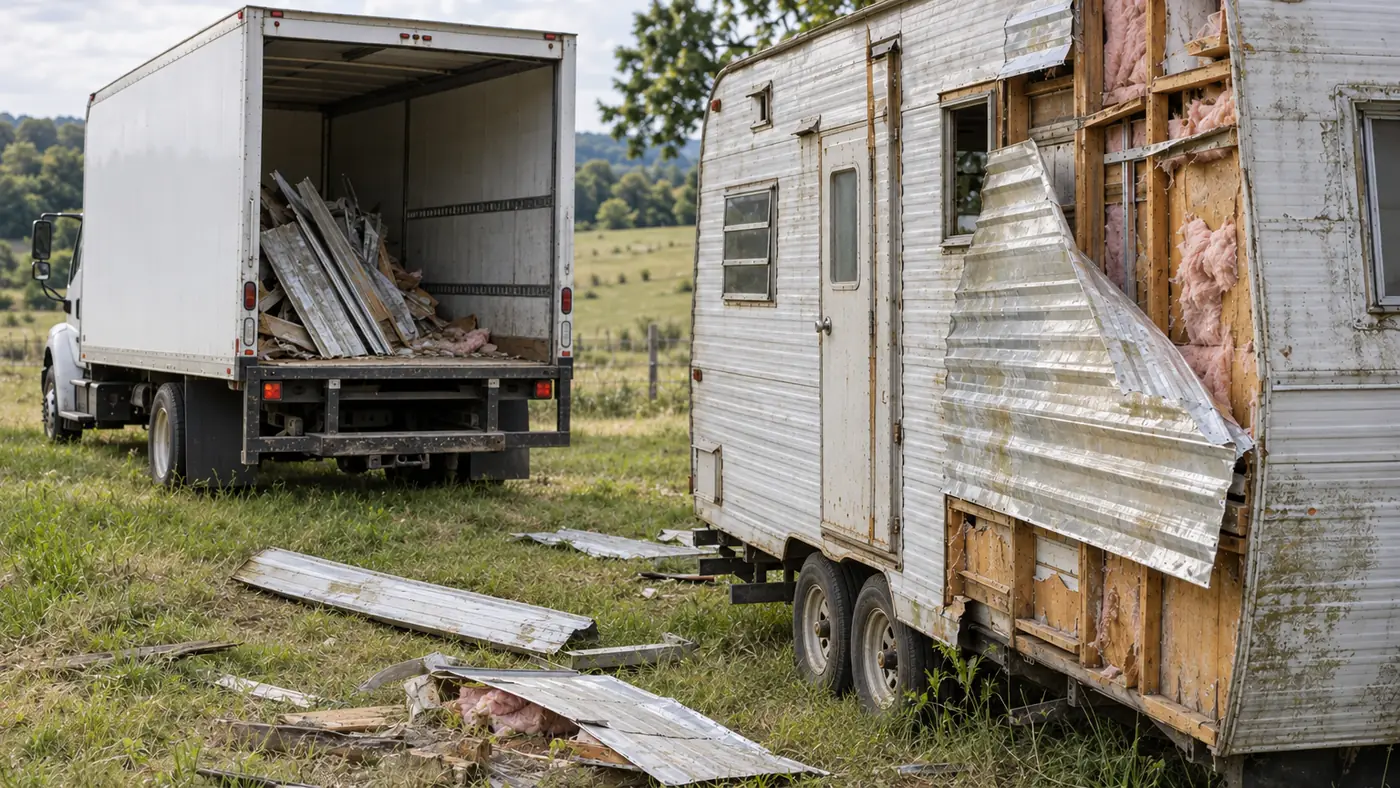
Some things are too big to call junk and too far gone to call anything else: the camper that has not moved since 2011, the boat that grew a tree through its cover, the old single-wide on the back forty that nobody has lived in for years. Junk Rhinos offers mobile home removal along with junk RV, camper, travel trailer and boat removal for units like these. We take them apart where they sit and haul the pieces away.
This page is honest about the details, because there are a lot of them. Titles, permits, utilities, fuel, propane and, in older homes, asbestos all matter before anyone picks up a tool. Read the short version below, then call us with the details of your unit.
- Insured, uniformed crews
- Free on-site estimate
- No deposit, no hidden fees
- Same or next-day in most areas
- We donate & recycle first
Published prices
What RV, camper and boat removal costs
Mobile homes are quoted on-site only. RVs, campers, trailers and small boats are priced by the truck space the dismantled unit fills: from $450 for a pop-up camper, and from $729 for a 20-30 ft travel trailer, which often takes more than one truck. The dismantling labor is added to your firm, all-in price.
- Single item~1/16 truckfrom $199
- 1/8 truck~half a pickup bedfrom $199
- 1/4 truck1 pickup bedfrom $290
- 1/2 truck~2 pickup bedsfrom $450Typical for this job
- 3/4 truck~3 pickup bedsfrom $590Typical for this job
- Full truck~18 cu ydfrom $729Typical for this job
Examples
- Pop-up camper, dismantled1/2 truck, from $450
- Small boat up to about 16 ft, no motor (half to three-quarters)1/2 truck, from $450
- Truck camper or small trailer under 20 ft3/4 truck, from $590
- 20-30 ft travel trailer (the whole truck and often more)Full truck, from $729
Ballpark prices from our published rates. The crew confirms your firm, all-in price free on-site before any work starts. No deposit. Pay online when you book, or after the job.
First, the free removal question
A lot of people search for free junk camper removal or free mobile home removal near them, and it is worth being straight about what that usually means. Free removal exists when the unit is worth something to the person taking it: a scrap buyer who wants the steel, a salvage yard that wants the parts, or a buyer who plans to fix it up.
Our service is the other kind. It is a paid removal service for units with no resale value: the RV that will never run again, the boat with a soft hull, the trailer with a collapsed roof. If yours still runs, still floats or still has a sound frame, try selling it first, list it for parts, or ask a scrap buyer for an offer. Some charities also accept donated vehicles, RVs and boats. If a scrap buyer offers to take your unit for free or pay you for it, take the offer; we would rather you save the money than book a removal you do not need. If none of that works out, we are here, and you will know the price before anything starts.
What the job involves
Every unit on this page is a frame with a structure bolted on top. RVs, travel trailers and campers are a steel chassis carrying wood framing, aluminum or fiberglass skin, cabinets, appliances, tanks and wiring. Boats are a fiberglass or aluminum hull, often with an engine and a trailer. A mobile home is the same idea at house scale, sitting on piers, tied down and connected to utilities.
The crew removes these by dismantling them on-site: stripping the interior, cutting the body into sections and loading the pieces into the truck. Whether a unit can be towed whole instead depends on its condition; ask when you book.
What our removal includes
Paperwork and walk-around
The crew confirms proof of ownership, looks at the unit and the access to it, and checks that fuel, propane and batteries have been dealt with. You get a firm price, or for mobile homes, a written on-site quote.
Interior first
Furniture, mattresses, appliances, cabinets, carpet and everything left inside come out first. Usable items are set aside for donation.
Dismantling
The body is taken apart in sections: roof, walls and skin first, then framing down to the chassis.
Loading and hauling
Every piece is loaded and hauled. Larger units take multiple loads, which the quote already reflects.
Site cleanup
We rake and sweep the footprint of screws, insulation and broken trim. Grading the ground and filling holes are not part of the job.
Removal jobs we handle
The units differ, but the calls sound similar. These are the ones that come up most, with the caveats that apply to each.
Junk RV removal
A motorhome or fifth wheel with a dead engine, a leaking roof and soft floors is a common call. The owner provides the title or proof of ownership, removes or confirms removal of the propane tanks, drains or confirms the fuel situation and pulls the batteries. The crew dismantles the unit in place; for large Class A motorhomes, ask first, because some are better handled by a salvage yard.
Junk camper removal
Pop-up campers and truck campers are the smaller end of this work. A pop-up with torn canvas and a rusted lift system breaks down quickly. Same rules apply: proof of ownership, no propane cylinders, no batteries.
Travel trailer removal
A 20-30 ft travel trailer used as a storage shed for a decade is one of our most typical versions of this job. The contents come out first, then the trailer is dismantled. Expect a full truck or more, and tell us if the trailer has sunk into the ground or lost its tires, since that changes access.
Boat removal
Small fiberglass and aluminum boats with no resale value are cut down and hauled. Outboard motors, fuel tanks and batteries need to be removed or confirmed empty and disconnected first. Whether the boat trailer goes too, and whether it needs its own paperwork, depends on your state; ask when you book.
Mobile home removal
This is the biggest and most regulated job on this page. Single-wide homes are quoted only after an on-site visit and usually take multiple loads over more than one day. Double-wides are a demolition project, and we refer those to a demolition contractor rather than pretend otherwise.
Clearing a mobile home before it goes
Sometimes the most useful thing we can do is empty the home first, whoever removes the structure. Furniture, appliances, decades of belongings and the shed out back are standard work for our crews. Our house cleanout and property cleanout pages cover that side of the job in detail.
Lots, parks and inherited land
Landowners, heirs and park managers often call about a unit someone left behind. We can only remove a unit when the person booking can show they own it or have legal authority to dispose of it. For park lots, the park's rules on access and timing apply too.
Straight talk
Before we arrive: what you need to handle
This section matters more here than on any other page we have. Rules vary by state and county, so treat what follows as a checklist of things to check, not legal advice.
Title and proof of ownership
For RVs, campers, travel trailers and boats, the owner must provide the title or other proof of ownership before removal. For mobile homes, many states treat the home as titled property, and removal or demolition may require the title, a demolition permit from the county and in some places a tax clearance showing property taxes are paid. Permits and title paperwork are the owner's to handle; your county assessor or building department can tell you what applies.
Utilities
A mobile home must have electricity, gas, water and sewer disconnected by the utility companies, or by licensed trades where the utility allows it, before any work starts. That is not something a removal crew should improvise.
Propane, fuel and batteries
Propane tanks and cylinders, gasoline, diesel, and batteries are your responsibility to remove before removal day, or to confirm with us in advance. These are hazardous or regulated materials.
Asbestos in older homes
Mobile homes built before the 1980s may contain asbestos in flooring, ceiling texture, wall panels, roof coatings or duct insulation. Asbestos is excluded from our service, full stop. If there is any chance it is present, a trained, accredited asbestos inspector should test first, and some jurisdictions require that before demolition. A trained, accredited asbestos professional, licensed where your state requires it, handles anything that tests positive.
Title, registration and utilities: who to call
Paperwork and utilities are the owner's side of the job, and each state, county and utility runs them its own way. The examples below show who to ask; the rules where you live may differ.
The state title agency
Start with the agency that titles mobile homes in your state. In Florida, for example, state law requires the owner named on the last title to surrender it to the Department of Highway Safety and Motor Vehicles when a mobile home is dismantled or destroyed, and the department cancels the title with the consent of any lienholder. If an RV, camper, trailer or boat is titled or registered, ask the agency that issued the paperwork what happens to the title, registration and plates.
The county
Counties can have their own steps. In Island County, Washington, the county treasurer says owners of a home being destroyed on site must pay the full year's current taxes and any prior taxes, bring proof of destruction to the assessor's office and contact the auditor's or Department of Licensing office. Your county assessor, treasurer or building department can tell you what applies where you live.
Each utility
Disconnection is done by the utility, or by licensed trades where the utility allows it, on the utility's terms. Pacific Gas and Electric in California, for example, requires gas service to a home scheduled for demolition to be cut and capped at or outside the property line. Call every provider, including water and sewer, well before removal day.
What we take and what we do not
- Dead RVs, motorhomes and fifth wheels
- Pop-up campers, truck campers and travel trailers
- Small boats with no resale value, with motors and tanks removed
- Single-wide mobile homes, after an on-site quote
- Contents, furniture and appliances from inside any of these units
- Steps, skirting, small decks and sheds around the unit
We do not take propane, fuel, oil, batteries, holding tank waste, paints or chemicals, and we do not touch asbestos-containing materials. Utility disconnection, permits and title paperwork stay with the owner. Foundations, slabs, grading and filling holes are not part of the job either.
What does mobile home removal cost?
Mobile home removal cost is quoted on-site only, because the size, construction, condition, access and number of loads vary too much for a ballpark to be useful. A single-wide takes multiple loads, and the written quote spells out the full job. RVs, campers, trailers and boats are priced like our other jobs, by the truck space the dismantled unit fills, plus the dismantling labor. As a rough guide, a dismantled pop-up camper takes about half the truck, a small boat up to about 16 ft with no motor takes half to three-quarters, a truck camper or small trailer under 20 ft fills about three-quarters, and a 20-30 ft travel trailer fills the whole truck and often more.
These are starting points for typical jobs, not quotes: the crew confirms a firm, all-in price on-site before starting, and our pricing page explains how the truck tiers work.
- Priced by the truck space your load fills
- Firm, all-in price confirmed free on-site
- No deposit, and nothing owed until it is done
- Labor, hauling and disposal fees all included
How long does it take?
A pop-up camper or small boat usually takes a few hours. A 20-30 ft travel trailer can take most of a day, and longer if it is full. A single-wide mobile home takes multiple days and multiple loads; the on-site quote includes a realistic timeline.
What happens to the materials
Steel frames, axles and aluminum skin go to metal recycling. Appliances, furniture and fixtures in usable condition are donated where a local charity will take them. Fiberglass, wood framing, insulation and carpet go to the appropriate disposal facility. Anything hazardous stays out of the truck altogether.
Frequently asked questions
How much does mobile home removal cost?
It is quoted on-site only, because every home differs in size, construction, condition and access, and most take multiple loads. RVs, campers and boats are priced by the truck space the dismantled unit fills plus the dismantling labor. Either way, the estimate is free and you know the firm, all-in price before any work starts.
Is there free mobile home removal near me?
Sometimes, if a buyer or salvage company sees value in the home. If it has none, removal is a paid service. It is worth asking around before you book anyone.
Can you remove a junk camper for free?
No, our camper removal is a paid service. If the camper still has value, a scrap buyer or private sale may take it for free or pay you, so try that first.
Do I need the title to get rid of an RV or boat?
Yes. We need the title or other proof of ownership for any RV, camper, trailer or boat. Your state may also want the title surrendered or transferred.
Do I need a permit to remove a mobile home?
Many states and counties require a demolition permit, the title and sometimes a tax clearance. Those are the owner's to arrange, so check with your county building department or assessor before booking.
Who disconnects the utilities?
The utility companies, or licensed trades where they allow it. All utilities must be disconnected before removal day.
Do you tow RVs or boats?
It depends on the unit's condition. Usually we dismantle on-site and haul in pieces. Ask when you book.
Do you remove double-wide mobile homes?
A double-wide is a demolition project, so we refer those to a demolition contractor. We can still clear the contents first.
What if the mobile home has asbestos?
Asbestos is excluded. Homes built before the 1980s should be tested first, and anything positive goes to a trained, accredited asbestos professional, licensed where your state requires it.
Do I need to remove the propane tanks?
Yes, or confirm it with us in advance. Propane, fuel and batteries are your responsibility before removal day.
Can you just clear out the inside of a mobile home?
Yes, that is standard junk removal. Furniture, appliances and belongings come out and usable items are donated.
Sources we checked
Rules and fees on this page come from these official sources. Local rules can differ, so check with your city or county too.
How to Properly Dispose of Batteries: A Type-by-Type Guide
Where lead-acid and other batteries go, since they have to come out before removal day.
How to Dispose of Paint: Latex, Oil-Based, and Spray Cans
What to do with paint cans left inside the unit, since paints and chemicals stay off the truck.
How to Clean Out a Parent's House After Death: A Gentle Guide
For heirs facing an inherited home and its contents: what to sort first and when to call a crew.
Ready when you are
Get the dead camper, the sunk boat or the empty single-wide off your land for good. Call (877) 283-1595 or request a free estimate online, and you will have a firm price before anyone picks up a tool.