Quick answer
The easiest way to dispose of old tires is to leave them at the shop when you buy new ones, since many states require tire sellers to take them back or fund recycling through a per-tire fee. For tires you already have, use a county tire drop-off, a landfill that accepts tires, a local tire collection day, or a junk removal crew that hauls them with the rest of your load. Never burn, bury or dump them.
Jump to section
Tires are one of the few household items with their own state rules. Several states cap how many tires a person can carry without a hauler registration, some ban whole tires from landfills, and most charge a fee on every new tire to pay for recycling.
Below are your options, what they cost, and the rules in six states whose agency pages we checked on November 17, 2026. If your state is not listed, your state environmental agency or county solid waste office has the local version.
Key takeaways
- Leaving old tires with the installer is usually the cheapest route, because you are often already paying a state tire fee on the new set.
- County drop-off sites and landfills take tires in many areas, often for a fee and sometimes free for residents with proof of address.
- States limit how many tires you can haul yourself. Ohio sets the line at 10, Florida at 25, and California requires a registered hauler for 10 or more.
- If you hire someone to haul a large tire load, check that they are allowed to. In Ohio and Florida, you can stay responsible if an unregistered hauler dumps your tires.
- Junk Rhinos takes tires on the same truck as the rest of your junk, priced by the space the load takes.
Why Tires Have Their Own Rules
A tire's curved shape holds rainwater, and standing water in a tire pile is a breeding spot for mosquitoes and rodents, according to the U.S. EPA's scrap tire page. Tire piles also catch fire, and those fires are hard to put out. The EPA notes they can burn for months and give off unhealthy smoke and toxic oils.
Whole tires also do poorly in landfills. Illinois EPA states plainly that whole tires are banned from landfills in Illinois, so they have to be recycled or processed instead. That is why states push tires toward recyclers, which turn them into fuel, ground rubber and fill for civil engineering projects.
The practical takeaway for a homeowner: keep old tires dry and covered until they leave, and send them somewhere that is allowed to accept them.
Option 1: Leave Them at the Tire Shop
When you buy a new set, the installer pulls the old tires off your car anyway. In many states the shop is required to take them back. Illinois EPA says retailers there must accept a number of used tires equal to the number of new tires you buy.
You are also paying toward disposal through a state fee on each new tire. A few examples from state pages:
- California charges a California tire fee of $1.75 per new tire under the state's tire fee law, as posted by the California Department of Tax and Fee Administration.
- New York's waste tire management and recycling fee is $2.50 per tire on most new tires sold at retail, collected by the tire service.
- Illinois charges a $2.50 per tire user fee on new and used tires sold at retail.
- Florida's $1 fee per new tire is imposed on the retailer, not the buyer, according to the Florida Department of Revenue.
Some shops also add a separate disposal charge for each old tire. Ask for the out-the-door price, including any tire disposal line, before you book the install. If you are not buying new tires, some shops will still take old ones for a fee, so it is worth a phone call.
Option 2: County Drop-Off Sites and Landfills
Many counties run a tire drop-off or accept tires at the landfill or transfer station. The Texas Commission on Environmental Quality tells homeowners that a landfill may accept tires directly but will usually charge a fee, and to call ahead to confirm the landfill takes tires.
Some programs are free for residents. Lorain County, Ohio, lets residents drop off passenger tires for free at its scrap tire collection sites with a driver's license or other proof of residency. Its sites take passenger, SUV, minivan and pickup tires up to a 20-inch rim, on or off the rim, plus bicycle and motorcycle tires. They do not take semi, trailer, farm or racing tires, or tires from businesses.
Those details are typical of county programs: residents only, passenger tires only, and a cap on rim size. Read your county's page before you load the car.
Option 3: Tire Collection Days
Counties and cities often hold tire amnesty days or bulky trash collection events. TCEQ points Texas homeowners to bulky trash events run by local governments as one way to get rid of tires from home. Expect a per-household limit and a residency check at many of these events. Your county's solid waste or public works page lists dates.
Option 4: Have Them Hauled With Everything Else
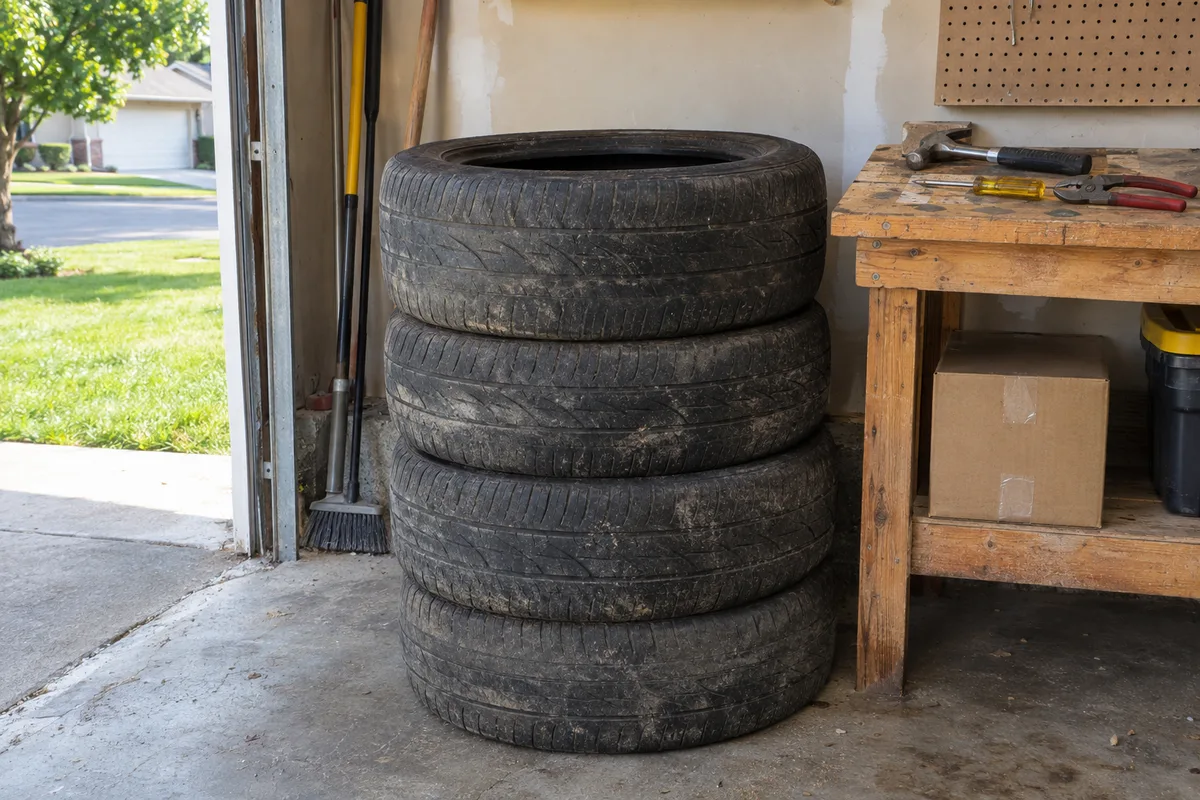
Tires rarely show up alone. They sit in a garage next to an old grill, a broken treadmill and a pile of boxes. A junk removal crew can take the tires along with the rest, so you make no trips to the landfill and stand in no lines.
Junk Rhinos takes tires on the same truck as the rest of the load. Pricing is by volume: you pay for the space the whole load takes in the truck, with loading, hauling and disposal included. A small load starts at the $199 minimum, a quarter truck (about one pickup bed) is $290 ballpark (see pricing), and a crew confirms the firm price on-site before any work starts. Tell us how many tires you have when you book so the crew can plan the trip.
See our garage cleanout page if the tires are part of a bigger clear-out, or general junk removal for a mixed load. Old steel rims and other metal can go too; see scrap metal removal. The full list of what we haul is on what we take, and what happens to junk after removal explains where a load goes.
One thing a hauler will not take with the tires: used motor oil, antifreeze, fuel and other car fluids. Those go to a household hazardous waste site or another collection point your county lists. We do not take them.
State Tire Rules We Checked
These are summaries of the state agency pages we read on November 17, 2026. Rules change, and counties can add their own, so confirm with your state agency before hauling a large load yourself.
| State | What the state page says |
|---|---|
| California | Anyone transporting 10 or more used or waste tires in the state must hold a valid waste tire hauler registration (CalRecycle). New tires carry a $1.75 per tire California tire fee (CDTFA). |
| Florida | Individuals may transport up to 25 waste tires without registering. More than 25 at a time requires a DEP waste tire collector registration. If you let an unregistered hauler take your tires and they are dumped, you can be fined or made to clean up (Florida DEP best practices sheet, May 2017). The $1 new tire fee is paid by the retailer. |
| Illinois | Whole tires are banned from landfills. Retailers must accept as many used tires as new tires sold. A $2.50 per tire fee applies at retail (Illinois EPA). |
| New York | A $2.50 waste tire management and recycling fee applies to most new tires sold at retail, collected by the tire service (NYS Department of Taxation and Finance). |
| Ohio | Anyone may transport 10 or fewer scrap tires without registering. More than 10 must go with a registered transporter, and the owner stays liable if an unregistered hauler dumps them (Ohio EPA Guidance Document 645, August 2023). |
| Texas | Landfills may accept tires for a fee. If you have many tires, you may need to hire a scrap tire transporter to take them to an authorized facility. TCEQ publishes a list of active tire handlers. |
What this means if you have a pile
A set of four from the garage is simple almost everywhere. A pile of 30 from a rental property or an old farm shed is different. In states like Ohio and Florida, a load that size has to move with a registered hauler, and the tire owner carries the risk if it ends up dumped. Ask any hauler how they handle a large tire load and where the tires go. For a big pile on land you just bought or inherited, call the state agency first.
What Not to Do With Old Tires
- Do not burn them. The EPA warns that tire fires are hard to put out and give off unhealthy smoke and toxic oils.
- Do not leave them out in the yard to collect rain. Drain them and keep them covered or indoors until pickup.
- Do not put them in your household trash or curbside bin unless your city says it accepts them.
- Do not hand a pile to someone who offers to take it for cash with no questions. In states like Ohio and Florida, you can be liable if they dump it.
Clearing the rest of the garage on the same visit saves you another trip. Our free quote form takes a ZIP code, a load size and optional photos, and same-day or next-day pickup is available in most areas.
Sources we checked
- CalRecycle, Used and Waste Tire Haulers, checked November 17, 2026.
- California Department of Tax and Fee Administration, California Tire Fee, Sec. 42885, checked November 17, 2026.
- Florida Department of Environmental Protection, Best Management Practices, General Public: How to Handle Used and Waste Tires, checked November 17, 2026.
- Florida Department of Revenue, What is the solid waste fee for tires, and who must pay it?, checked November 17, 2026.
- Illinois EPA, Used Tire Facts, checked November 17, 2026.
- New York State Department of Taxation and Finance, Waste tire management and recycling fee, checked November 17, 2026.
- Ohio EPA, Guidance Document 645: Scrap Tire Generator, checked November 17, 2026.
- Lorain County, Ohio, Tire Disposal, checked November 17, 2026.
- Texas Commission on Environmental Quality, Disposing of Tires from Your Home or Private Property, checked November 17, 2026.
- U.S. EPA (archived), Scrap Tires: Basic Information, checked November 17, 2026.
Frequently asked questions
Can I put old tires in my trash can?
Usually not. Most cities do not collect tires curbside, and Illinois bans whole tires from landfills. Check your city's trash rules, then use a tire shop, a county drop-off or a hauler.
How many tires can I haul myself?
It depends on the state. Ohio allows 10 or fewer without a transporter registration, Florida allows up to 25 waste tires, and California requires a registered hauler for 10 or more. Check your state agency for the current rule.
Does the tire shop have to take my old tires?
In some states, yes, when you buy new ones. Illinois requires retailers to accept as many used tires as you buy new. Elsewhere it depends on the shop, so ask before the install.
Will Junk Rhinos pick up tires?
Yes. Tires can go on the same truck as the rest of your load, and the price is based on how much space the whole load takes. Tell us the count when you book.
Do you take motor oil or antifreeze with the tires?
No. We do not take motor oil, antifreeze, fuel or other car fluids. Take them to a household hazardous waste site or another collection point your county lists.